
Why Choosing the Right Water Heater Matters for Tulsa Homes
Water heaters best in Tulsa, OK depends on your home’s size, hot water usage, budget, and whether you prefer the reliability of a traditional tank or the efficiency of a tankless unit. Most Tulsa families choose between conventional storage (tank) models that keep 30-80 gallons ready, tankless systems that heat water on demand, or hybrid heat pump units that blend both approaches. The right choice depends on your household’s daily hot water needs, your home’s existing fuel hookups, and how Tulsa’s hard water affects your equipment over time.
Quick Answer: Top Water Heater Types for Tulsa Homes
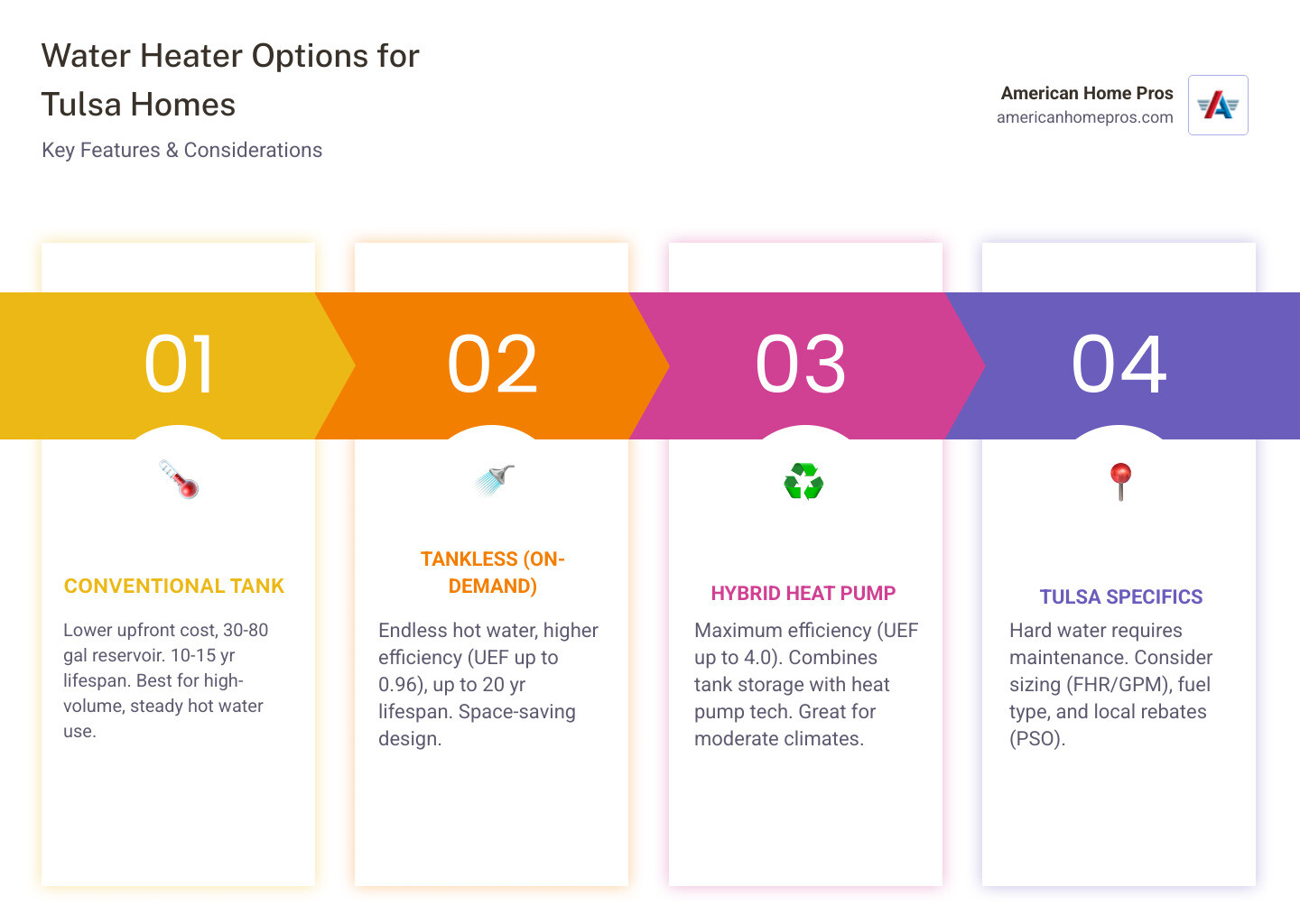
- Conventional Storage (Tank): Best for families needing steady, high-volume hot water; lower upfront cost; 10-15 year lifespan
- Tankless (On-Demand): Best for smaller households or efficiency seekers; endless hot water; up to 20-year lifespan; higher initial investment
- Hybrid Heat Pump: Best for maximum efficiency; combines tank storage with heat pump technology; ideal for moderate climates
There’s nothing worse than stepping into a cold shower on a winter morning because your water heater gave out overnight. Whether you’re building new, replacing an aging unit, or just tired of running out of hot water during back-to-back showers, finding the right water heater for your Tulsa home means balancing upfront investment, energy bills, space, and how much hot water your family actually uses. Tulsa’s hard water adds another layer to the decision—certain models handle mineral buildup better than others, and regular maintenance becomes even more important to protect your investment.
If you’re dealing with water heater issues or ready to upgrade, American Home Pros offers transparent pricing, expert installation, and ongoing support—schedule your service today.
As Cody Dampf, President of American Home Pros and a veteran who’s spent years in the plumbing and HVAC trades, I’ve helped hundreds of Tulsa families steer the water heaters best in Tulsa, OK for their unique situations, from sizing the right tank to explaining why tankless might save you money long-term. My goal is to help you make a confident, informed choice that keeps your family comfortable for years to come.
Understanding Your Water Heater Options
When it comes to keeping your home comfortable and your showers warm, understanding the different types of water heaters available is the first step. For homeowners in Tulsa, OK, we generally see three main types dominate the market: conventional storage (tank) water heaters, tankless (on-demand) water heaters, and hybrid heat pump water heaters. Each has its own set of characteristics, advantages, and considerations that make it more or less suitable for different households.
Our team at American Home Pros works with all types, ensuring we can provide the right solution for your specific needs. From installation to repair and maintenance, we’re here to ensure your hot water flows freely. You can explore all our plumbing services, including comprehensive Water Heaters solutions, right here.
Conventional Storage (Tank) Water Heaters
The conventional storage water heater is what most of us picture when we think of a water heater. It’s that large, cylindrical tank typically found in a utility closet, basement, or garage. These units work by storing and heating a set amount of water, usually between 30 and 80 gallons, keeping it at a consistent temperature until it’s needed.
Advantages:
- Lower Initial Investment: Generally, tank water heaters have a lower upfront cost compared to tankless or hybrid models, making them a popular choice for many.
- Proven Technology: These units have been around for a long time, and their technology is well-understood and reliable.
- Ease of Installation: For homes already set up for a tank water heater, installation is often straightforward and quicker.
- Consistent Temperature: Because the water is pre-heated and stored, you typically get a very consistent temperature from the tap until the tank’s hot water supply is depleted.
Disadvantages:
- Standby Heat Loss: Even with insulation, stored hot water loses heat over time, meaning the unit constantly reheats water, which can be less energy-efficient.
- Limited Supply: Once the tank’s hot water is used up, you have to wait for it to refill and reheat, which can be inconvenient for larger families or during peak usage times.
- Space Requirements: The large tank takes up a significant amount of floor space.
- Shorter Lifespan: Tanked water heaters typically have a lifespan of 10 to 15 years.
Tankless (On-Demand) Water Heaters
Tankless water heaters, as the name suggests, don’t store hot water. Instead, they heat water only when you need it, on demand. When you turn on a hot water tap, cold water travels through a pipe into the unit, where a gas burner or electric element quickly heats it. This provides a continuous supply of hot water, as long as the unit is properly sized for your household’s needs.
Advantages:
- Continuous Hot Water: The most celebrated benefit is the endless supply of hot water. No more cold showers, even if you’re the last one in the family. A ten-minute shower can turn into an hour-long spa treatment!
- Energy Efficiency: Because they only heat water when it’s needed, tankless units avoid standby heat loss, making them significantly more energy-efficient. In fact, tankless water heaters are often considered the most energy-efficient option as they heat water on demand.
- Longer Lifespan: Tankless water heaters can be expected to last up to 20 years with regular maintenance, almost double that of conventional tanks.
- Space-Saving Design: These compact units are often wall-mounted, freeing up valuable floor space in your home.
Disadvantages:
- Higher Initial Cost: Tankless units typically have a higher upfront investment compared to tank models.
- Potential for Inconsistent Temperature: If multiple hot water taps are used simultaneously, some tankless units might struggle to maintain consistent temperatures or flow rates, depending on their capacity.
- Installation Complexity: Installation can be more complex, sometimes requiring upgrades to gas lines or electrical systems.
Are you curious if a tankless water heater is the right fit for your home? We’ve put together a dedicated guide to help you decide: Is a Tankless Water Heater Right For You?
Tank vs. Tankless: A Head-to-Head Comparison
Choosing between a tank and tankless water heater is a big decision for many Tulsa homeowners. Let’s put them head-to-head on key features to help you weigh your options:
| Feature | Conventional Storage (Tank) Water Heater | Tankless (On-Demand) Water Heater |
|---|---|---|
| Lifespan | 10-15 years | Up to 20 years (with regular maintenance) |
| Energy Efficiency | Lower (due to standby heat loss) | Higher (heats water only when needed) |
| Upfront Investment | Generally lower | Generally higher |
| Hot Water Supply | Limited by tank size; can run out | Continuous; endless hot water |
| Space Requirements | Large, cylindrical tank; takes up floor space | Compact, wall-mounted; saves space |
| Maintenance Needs | Annual flushing, anode rod inspection | Annual flushing, descaling (more critical in hard water areas) |
Which is one of the water heaters best in Tulsa, OK for your family?
Deciding which type of water heater is best for your family often comes down to a few key considerations:
- Household Size and Hot Water Usage Habits: Larger families with frequent, simultaneous hot water demands (e.g., multiple showers, laundry, and dishwasher running at once) might find the continuous supply of a tankless unit appealing, provided it’s appropriately sized. For smaller households or those with staggered usage, a conventional tank might suffice.
- Budget Considerations: While tankless units have a higher initial investment, their energy efficiency can lead to significant long-term savings on utility bills. It’s a trade-off: lower upfront cost for tank models versus potential savings over time with tankless.
- Long-Term Savings Goals: If energy efficiency and lower monthly bills are a priority, the tankless option or even a hybrid heat pump model, despite its initial cost, could be a smarter long-term investment. Heating water is often the second leading energy charge in a home, so efficiency really matters!
The water heaters best in Tulsa, OK for your family is the one that reliably meets your hot water needs, fits your budget, and aligns with your energy-saving goals.
Key Factors for Finding the Water Heaters Best in Tulsa, OK
Beyond just choosing between tank and tankless, there are several other crucial factors that Tulsa homeowners should consider. Making an informed choice now can save you headaches and money down the road.
Sizing Your Water Heater Correctly
One of the most common mistakes we see is an improperly sized water heater. An undersized unit means cold showers and frustrated family members. An oversized unit means wasted energy and higher operating costs.
- For Tank Models: We look at the First Hour Rating (FHR). This indicates how many gallons of hot water the heater can supply during an hour of peak demand. We consider the number of people in your household and your peak usage patterns (e.g., how many showers are typically taken in the morning).
- For Tankless Models: We focus on Gallons Per Minute (GPM). This measures how much hot water the unit can produce simultaneously. If you want to run a shower and a dishwasher at the same time, the unit needs enough GPM to handle both without a drop in temperature or pressure.
Custom water heater sizing is based on assessing your household’s unique hot water needs for optimal performance and energy efficiency. It’s not a one-size-fits-all solution, and our experts are here to help you get it right.
Fuel Type and Energy Efficiency
The type of fuel your water heater uses—and its efficiency—will significantly impact your utility bills. In Tulsa, we primarily deal with natural gas and electric options.
- Natural Gas: Natural gas is often a cost-effective fuel source in our area. Gas water heaters are common for both tank and tankless models.
- Electric Options: Electric water heaters are widely available in conventional storage, tankless, and heat pump systems. While electricity might sometimes be more expensive per unit than natural gas, highly efficient electric heat pump water heaters can still offer lower energy costs than a gas-fired conventional storage water heater, even if natural gas is locally cheaper than electricity, due to their superior energy efficiency.
- Energy Efficiency Ratings: Look for the Energy Factor (EF) or Uniform Energy Factor (UEF) rating. A higher EF or UEF indicates greater efficiency. Modern water heaters are significantly more energy-efficient than older models, so upgrading can lead to substantial savings.
We always recommend exploring options on the Energy.gov website for more detailed information on selecting an energy-efficient water heater. Furthermore, keep an eye out for local utility rebates! Providers like PSO in our service areas (including Tulsa, Broken Arrow, Owasso, and others) often offer incentives for installing energy-efficient water heaters, helping to offset the initial investment.
How Tulsa’s Water Quality Affects Your Unit
Here in Tulsa, we’re familiar with hard water. While it’s safe to drink, hard water can be tough on your plumbing system, especially your water heater.
- Mineral and Sediment Buildup: Hard water contains dissolved minerals like calcium and magnesium. Over time, these minerals can settle at the bottom of your water heater tank as sediment. This buildup reduces the heater’s efficiency, makes it work harder, and can even lead to premature failure. For tankless units, these minerals can scale on the heating elements, causing similar issues.
- Anode Rod Function: Tank water heaters have an anode rod, often called a “sacrificial rod.” This rod is designed to corrode before the tank itself, protecting the steel interior from rust. In hard water areas, the anode rod can deplete faster, requiring more frequent inspection and replacement.
- Importance of Flushing: Regular flushing of your tank water heater is crucial to remove sediment buildup. For tankless units, periodic descaling is necessary to prevent mineral deposits from impacting performance.
- Water Softeners: Many Tulsa homeowners consider installing a water softener to mitigate the effects of hard water on their entire plumbing system, including their water heater. This can significantly extend the lifespan and efficiency of your unit.
Understanding and addressing Tulsa’s water quality is key to ensuring the longevity and optimal performance of your new water heater.
Is It Time for a Repair or Replacement?
Even the most robust water heaters best in Tulsa, OK won’t last forever. Knowing when to repair and when to replace can save you from a major plumbing emergency and keep your hot water flowing.
We’ve helped countless Tulsa residents with water heater issues. For example, we’ve handled Tulsa Water Heater Replacement: 13-Year-Old Unit with Bad Thermopile, a common scenario highlighting the need for timely replacement.
5 Telltale Signs Your Water Heater is Failing
- Inconsistent Water Temperature: If your hot water is lukewarm, fluctuates wildly, or runs out much faster than usual, your water heater is struggling. This could be due to a failing heating element, a faulty thermostat, or significant sediment buildup.
- Strange Noises (Rumbling, Popping): A noisy water heater often indicates sediment buildup in the tank. As the heating element attempts to heat water through layers of sediment, it can create rumbling or popping sounds. This reduces efficiency and can damage the tank.
- Rusty or Discolored Water: If your hot water comes out rusty or discolored, especially from all hot water taps, it could be a sign that the inside of your water heater tank is corroding. This often means the tank is nearing the end of its life.
- Leaks Around the Base: Any standing water or dripping around the base of your water heater is a serious red flag. Leaks can stem from pressure relief valve issues, loose connections, or a crack in the tank itself. A leaking tank usually necessitates a full replacement.
- Unit is Over 10-15 Years Old: As mentioned, tanked water heaters typically have a lifespan of 10 to 15 years. If your unit is approaching or has exceeded this age, even without obvious problems, it’s wise to start considering replacement. Older units are less efficient and more prone to sudden failure.
Essential Maintenance for the Water Heaters Best in Tulsa, OK
Regular maintenance is the secret sauce to extending the life of your water heater and keeping it running efficiently, especially with Tulsa’s hard water.
- Annual Flushing: For tank water heaters, we recommend an annual flush to remove sediment buildup. This simple step can dramatically improve efficiency and prevent costly repairs.
- Checking the Pressure Relief Valve: This crucial safety device prevents excessive pressure buildup in the tank. We periodically test it to ensure it’s working correctly.
- Inspecting the Anode Rod: As we discussed, the anode rod sacrifices itself to protect your tank. We inspect it periodically and replace it when necessary, especially in hard water areas like Tulsa.
- Temperature Setting Check: We ensure your thermostat is set to an optimal temperature (usually around 120°F) for safety and efficiency.
- Professional Tune-ups: Just like your car, your water heater benefits from professional attention. Our skilled technicians can perform comprehensive inspections, identify potential issues early, and ensure your unit is operating at peak performance. Regular maintenance of tankless water heaters can extend their lifespan up to 20 years.
Conclusion: Your Partner for Reliable Hot Water in Tulsa
Choosing the water heaters best in Tulsa, OK is a significant decision for your home’s comfort and your wallet. Whether you opt for the proven reliability of a conventional storage tank, the energy efficiency and endless hot water of a tankless system, or the advanced savings of a hybrid heat pump, understanding your options is key. We’ve explored the advantages and disadvantages of each, the critical role of proper sizing, the impact of fuel type and energy efficiency (including potential PSO rebates), and how Tulsa’s hard water necessitates diligent maintenance.
The goal is a consistent, reliable supply of hot water, free from frigid surprises. While DIY fixes might seem tempting, the benefits of hiring a professional plumber for water heater services in Tulsa are clear. Our licensed and insured technicians ensure safety compliance, proper installation, and optimal performance, giving you peace of mind.
At American Home Pros, we’re a veteran-owned HVAC and plumbing company dedicated to serving Tulsa, OK, and surrounding areas like Broken Arrow, Owasso, and Jenks. We pride ourselves on our skilled technicians, transparent pricing, and a steadfast commitment to customer satisfaction, treating every customer like family. We understand the simple joy of a hot shower in the morning, and we’re here to ensure that joy is never interrupted.
Don’t let a failing water heater ruin your day. Contact us today to discuss your water heater needs, schedule an inspection, or explore your upgrade options.
Contact American Home Pros To Ensure The Hot Water Flows
